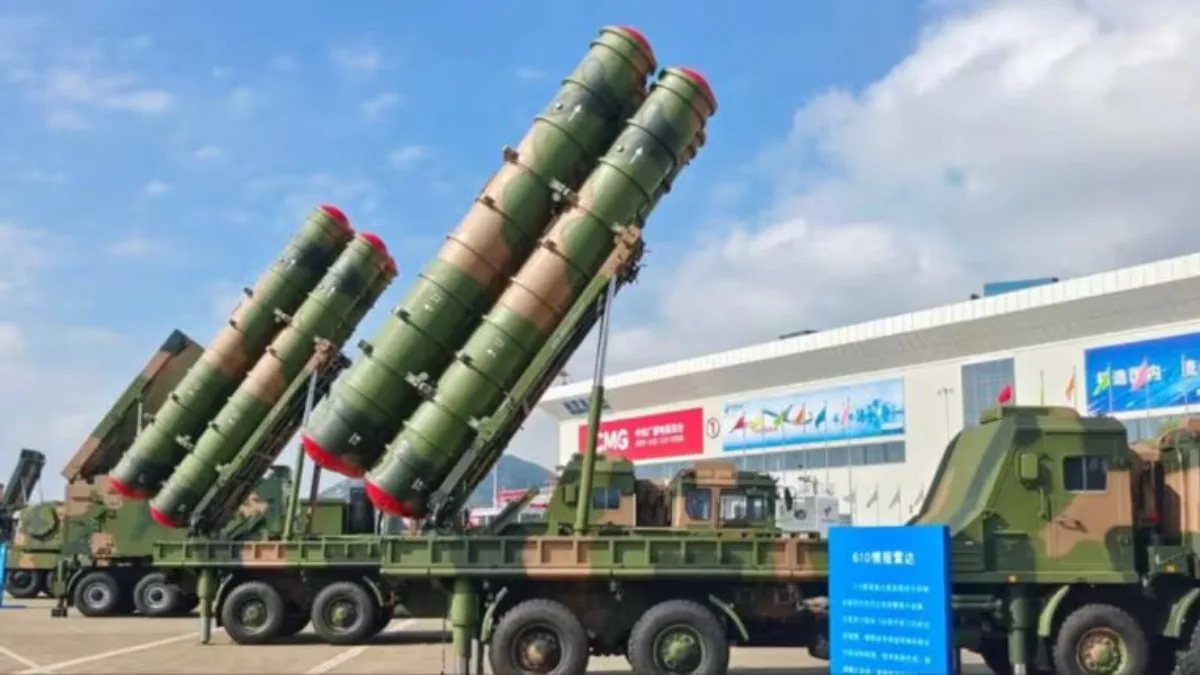
While large-scale airstrikes carried out by the United States and Israel cause huge damage to Iranian facilities, questions over the effectiveness of the Chinese-origin HQ-9B long-range surface-to-air missile system have renewed. Reportedly, Tehran recently inducted them into its arsenal.
The coordinated strikes reportedly targeted key Iranian installations, including a compound linked to Supreme Leader Ayatollah Ali Khamenei and critical nuclear facilities. Reports suggest that Iran deployed the HQ-9B air defence system to shield sensitive nuclear sites. However, the air defence system was unable to protect high-value locations during the assault.
Advertisement
It’s Iran’s turn this time to suffer the proverbial cheap and unreliable ‘Chini’ defence equipment HQ-9B after Pakistan was left red-faced during Operation Sindoor. In 2025, during Operation Sindoor, the Indian Air Force neutralised multiple HQ-9 air defence batteries. The operation was launched in response to the Pahalgam terror attack. The Chinese system failed to shield strategic assets in Pakistan targeted during the operation. Bangladesh and Sri Lanka, too, have been crying over faulty armament from Beijing.
China, meanwhile, has officially denied supplying the HQ-9 system to Iran, distancing itself from claims regarding the system’s deployment.
What is the HQ-9B?
The HQ-9B is a long-range surface-to-air missile system developed by the China Aerospace Science and Industry Corporation. The system design is inspired from Russia’s S-300PMU and the US-made Patriot PAC-2 system, though Chinese authorities call it an entirely indigenous platform.
First tested in 2006 and operational for over a decade, the system is reported to have a maximum engagement range of around 260 kilometres and an interception altitude of up to 50 kilometres. It is designed to counter a range of aerial threats, including fighter aircraft, cruise missiles, and certain types of ballistic missiles.
The HQ-9B is said to feature active radar homing along with a passive infrared seeker, intended to improve performance against stealth aircraft and electronic countermeasures. According to available specifications, it can track as many as 100 targets simultaneously and engage between six and eight at a time.
China has deployed the HQ-9B across strategically significant locations, including Beijing, Tibet and the South China Sea, underscoring its central role in the country’s integrated air defence grid.